


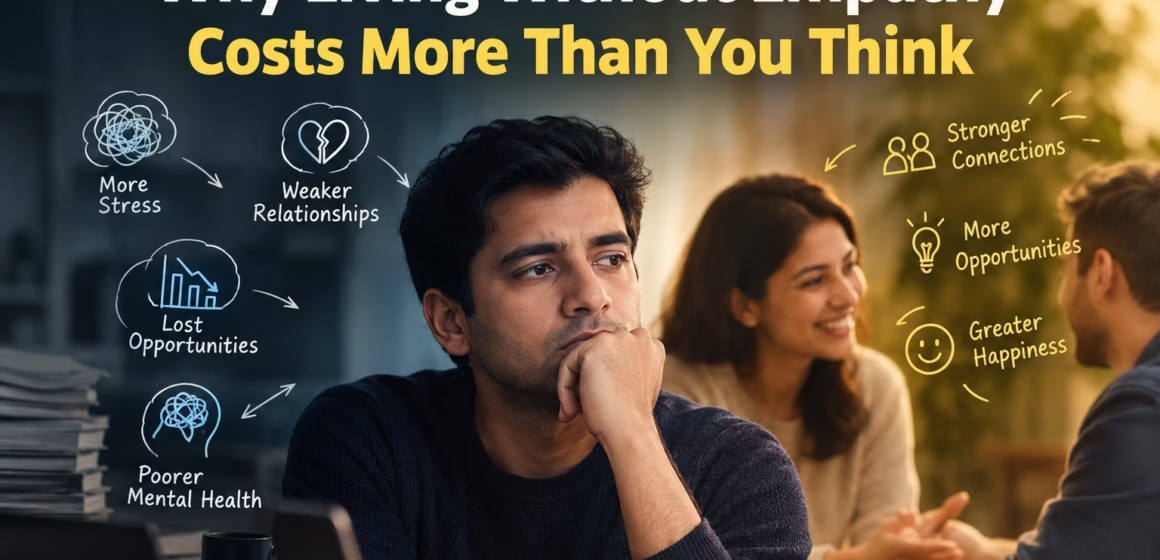
Why Living Without Empathy Costs More Than You Think
Empathy is a term often heard in leadership circles but rarely explored in depth. So what does it actually mean?
Empathy is understanding another person's views by putting yourself in their shoes, without rushing to judge or offer advice. Embracing empathy helps us stay grounded by integrating diverse perspectives into our understanding of reality. The key to developing empathy is good listening and asking open-ended questions that help you reach a deeper understanding.
Empathy is not about agreeing to please others, avoiding conflict, or blending in with the crowd. It's about respecting others' perspectives while still asserting your own views and boundaries. It allows others to succeed without you compromising your own values or beliefs.
Yet, despite its immense benefits, people struggle to exercise empathy in daily life. Fast-paced lifestyles, biases, and self-interest often create barriers to it. This article explores the significant consequences of neglecting empathy — consequences that can add up to a less fulfilling life.
You risk making bad decisions
If you shut down criticism, control conversations, or dismiss differing opinions, you lose the path to finding the truth — an essential element of sound decision-making.
We need to acknowledge that our minds, senses, and bodies have inherent limitations. We can't access all the information available at a given time, nor can we practise absolute objectivity. Success can blind us, and failure can discourage us. It's critical to stay grounded in these situations in order to make the right decision.
Empathy keeps you open to questions by making you aware of your own weaknesses. It helps you not only build a good team but also keep critics close — people who can spot the grey areas in your decisions before they lead to unrecoverable loss.
You have difficulty dealing with people
We all have an ego — an emotional, reactive part of the brain — and most of the time, we aren't even aware of our own. As a result, we react to situations that don't favour us, such as conflict, often with uncontrolled emotion. These reactions get in the way of building relationships anywhere.
Empathy helps you recognise that, just like yours, other people's egos also have their limits. You come to understand that an ego tells you a perspective, not the truth. You learn to expect in advance that some egos may misbehave, manipulate, or try to use you — and this early preparation helps you respond calmly and with controlled emotion when it happens.
You struggle to balance emotion and rationality
Life is best lived with a balance of rationality and emotion. We move through various settings simultaneously — personal relationships, family, friends, business — and each calls for a different balance. We can't let emotion cloud our judgement in business, but too much rationality in family matters can make relationships feel cold.
Empathy empowers you to understand the context of every setting from a deeper angle, so you can calibrate the right amount of each. Business, for example, might call for something like 90% rationality and 10% emotion, while family might call for closer to 50/50.
Conclusion
Personal growth is a journey, not a final destination, and that journey starts with developing awareness of our inner selves. While we've explored some of the key areas where a lack of empathy can cost us a great deal, it's worth remembering that empathy touches every aspect of life. By embracing it, we not only foster deeper connections with others but also strengthen our own emotional intelligence — ultimately leading to a more fulfilling life.